

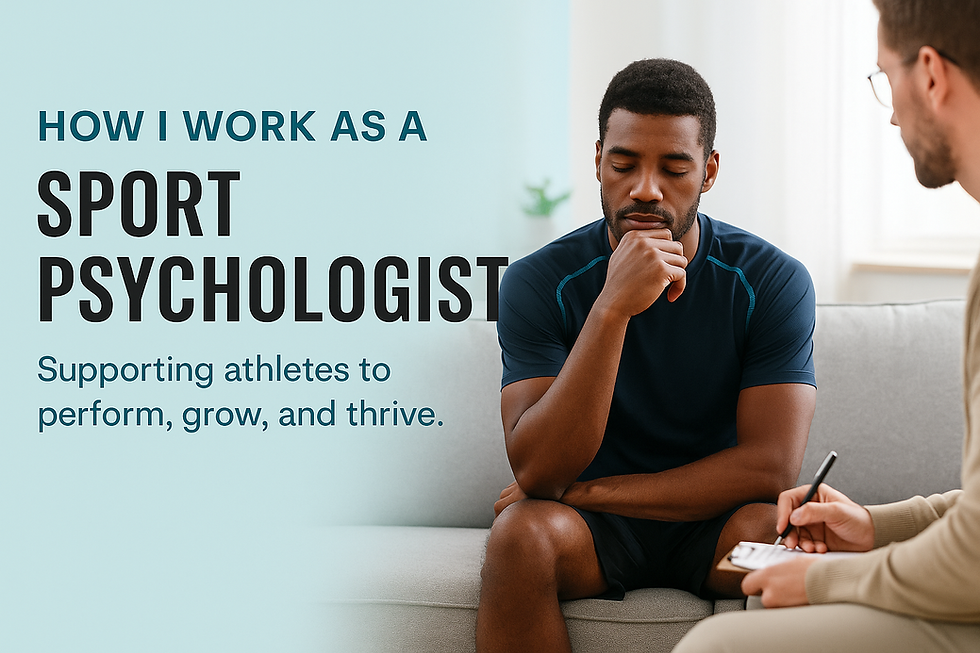
How I work as a Sport Psychologist
- Dylan Rodgers
- Nov 1, 2025
- 4 min read

Supporting athletes to perform, grow and thrive.
Understanding My Approach
Working with a sport psychologist is about more than improving performance. It is about understanding yourself as both an athlete and a person.
Performance in sport is complex. It is influenced by many factors such as physical preparation, technical skill, tactics, environment, and wellbeing. The mental side connects all of these. My approach focuses on helping you train and develop that mental component of performance so that you can perform consistently and confidently, while also supporting your wellbeing beyond sport.
The Foundation: Building the Relationship First
Every successful working relationship begins with trust. Before introducing any techniques or interventions, I take time to build a strong, supportive relationship with each athlete.
Understanding who you are, what matters to you, and the environment you operate in allows me to create an approach that fits you and your context. No two athletes are the same, and no single method works for everyone.
Research in applied sport psychology shows that the quality of the working relationship between the psychologist and the athlete is one of the strongest predictors of success (Tod & Eubank, 2020). That is why I place so much importance on developing a genuine, open, and collaborative relationship.
Understanding Your Context
Each athlete’s situation is different. You may be competing professionally, balancing sport and education, or managing life alongside your performance goals.
Taking time to understand your context means that any strategies we use are tailored and relevant to you. Whether we are working on confidence, focus, motivation, or managing pressure, everything we do is specific to your needs and your sporting environment.
Integrating ACT and PST: Training the Mental Side of Performance
My approach combines two complementary frameworks: Acceptance and Commitment Therapy (ACT) and Psychological Skills Training (PST).
ACT helps you build awareness, develop psychological flexibility, and act in line with your values, even when faced with uncomfortable thoughts or emotions. It focuses on learning to work with your mind rather than against it.
PST develops practical, trainable mental skills such as focus, imagery, goal setting, confidence, and emotional regulation.
Together, ACT and PST provide a balanced framework for developing both understanding and action.
You learn to manage the mental side of performance and apply the tools that help you stay composed, focused, and consistent when it matters most.
Research has consistently shown that ACT and mindfulness-based approaches improve focus, confidence, and performance, while also enhancing wellbeing (Gardner & Moore, 2007; White et al., 2021; Weinberg & Gould, 2019).
Building Psychological Flexibility
At the heart of my work is the concept of psychological flexibility.
This means being able to stay present, manage internal experiences effectively, and act in line with your values, even when things are difficult.
Athletes who develop psychological flexibility are more adaptable, resilient, and balanced. They can manage pressure, recover from setbacks, and perform consistently in high-stress environments.
Supporting the Whole Person
Sport psychology is not just about performance.
It is also about wellbeing, identity, and balance.
You are a person first and an athlete second.
When you feel well, supported, and connected to what matters, your performance improves naturally.
My approach focuses on both the person and the performer. This aligns with research on thriving in high-performance sport (Henriksen et al., 2020) and the WExceLLence model (White et al., 2021), which highlight that environments supporting both wellbeing and excellence lead to sustainable success.
What Working Together Looks Like
Here is what you can expect when we work together:
✅ Initial consultation to discuss your needs, goals, and context.
✅ Individual sessions focused on the areas most relevant to you, integrating ACT and PST principles.
✅ WhatsApp support between sessions for ongoing communication, reflection, and guidance.
✅ Access to evidence-based resources that I create and send to support your progress and reinforce what we discuss in sessions.
✅ A flexible and collaborative approach designed to help you develop lasting skills, not just short-term fixes.
Sessions are available both online and in person.
Pricing
💡 Individual sessions: £50 per session
💡 8-session package: £350 (includes between-session WhatsApp support and access to tailored resources)
Most athletes find that six to eight sessions provide the right foundation to build confidence, awareness, and psychological flexibility.
Who I Work With
I work with athletes, coaches, and teams across a range of sports and competitive levels. Whether you are preparing for a big event, managing nerves, rebuilding confidence, or seeking more balance alongside your sport, sessions are always adapted to meet your specific goals.
Final Thought
My aim is to help athletes develop the awareness, skills, and mindset to perform at their best while staying connected to who they are as people.
Through reflection, consistent practice, and support, we can build the psychological flexibility and mental strength that support both high performance and wellbeing.
Because sport psychology is not just about competing better.
It is about helping you perform, grow, and thrive — in sport and in life.
To learn more or to enquire about working together, visit The Sporting Brain.
Research-Informed Foundations
Gardner & Moore (2007). Mindfulness-Acceptance-Commitment (MAC) Approach.
White et al. (2021). ACT for Athletes.
Weinberg & Gould (2019). Foundations of Sport and Exercise Psychology.
Henriksen et al. (2020). Thriving in High-Performance Sport.
Durand-Bush et al. (2022). The Gold Medal Profile for Sport Psychology.
Tod & Eubank (2020). Applied Sport, Exercise, and Performance Psychology: Current Approaches to Helping Clients.

Comments